




There are a lot of electric scooter manufacturers, resellers, and models to choose from, and every one of them ships with a spec sheet full of numbers. The problem isn't finding specs. It's knowing which ones actually matter for how you plan to ride, and which ones are just there to amaze.
This guide walks through the specs that show up on nearly every electric scooter listing, explains what each one means in practice, and shows how they play out across four Apollo models: the Dash, Go Stellar, City 2.0, and Phantom 2.0.
Start with a needs assessment, not a spec sheet
Before comparing any numbers, it helps to know what you actually need a scooter to do. Specs only become useful once you know what you're measuring them against and wha they mean for riding. Consider "must haves" versus "would be nice," and don't trade one of the former for one of the latter. A needs assessment usually comes down to five questions:
-
Main use - Commuting, errands, or recreation? Pavement cruising or rougher terrain?
-
Riding conditions - Pavement or off-road, hills, and how often you'll ride in rain or cold.
-
Use and storage - Stairs, apartment storage space, and how often it needs to travel with you.
-
Performance - Desired cruising speed, top speed, and the range a typical ride requires.
-
Budget - What you're willing to spend, and where you're willing to compromise.
Apollo scooter specifications at a glance
Here's how four Apollo models compare across the specs covered in this guide.
|
Spec |
Dash |
Go Stellar |
City 2.0 |
Phantom 2.0 |
|
Top speed |
32 km/h |
51 km/h |
51 km/h |
70 km/h |
|
Nominal motor power |
600W |
2 x 500W |
1,200W |
2 x 1,560W |
|
Peak motor power |
1,200W |
2 x 1,000W |
1,900W |
2 x 1,750W |
|
Battery capacity |
48V 10Ah |
48V 13.45Ah |
48V 18Ah |
52V 27Ah |
|
Battery in watt hours |
480 Wh |
646 Wh |
864 Wh |
1,404 Wh |
|
Range (up to) |
25 mi (40 km) |
38 mi (61 km) |
40 mi (65 km) |
50 mi (80 km) |
|
Brakes |
1 drum + regen |
Drum + dual regen |
Drum + regen |
2 disk + dual regen |
|
Suspension |
None |
Dual spring |
AirFlow (F&R) |
Dual spring |
|
Tire size & type |
9.5" self-healing |
9.5" self-healing |
10" self-healing |
11"x4" self-healing |
|
IP rating |
IP66 |
IP66 |
IP66 |
IP66 |
|
UL certification |
UL 2271 & 2272 |
UL 2271 & 2272 |
UL 2271 & 2272 |
UL 2271 & 2272 |
|
Weight |
43 lbs (19.5 kg) |
55 lbs (25 kg) |
72 lbs (33 kg) |
102 lbs 46 kg) |

What does top speed actually mean on an electric scooter?
Top speed is the maximum achievable speed for a light to mid-weight rider (about 120 to 165 lbs) on flat ground, with a full battery, in the highest speed and torque setting. Treat it as a ceiling, the best case scenario, not a cruising speed. It will be hard, if not impossible to sustain it for long, and running near it drains the battery quickly.

What's the difference between nominal and peak motor power?
Motor power is measured in watts, and specs typically list two figures:
-
Nominal power is what the motor can sustain continuously without overheating. It's the better indicator of everyday performance: cruising speed, hill-holding ability, and how the scooter feels on a normal ride. Take this when comparing your average speed / power.
-
Peak power is the higher wattage a motor can deliver for brief bursts, such as accelerating from a stop or powering up a short steep grade, before the controller pulls back to protect the motor and battery. Take this if you’re looking for high acceleration power.
Even scooters with similar wattage can feel different, since motor efficiency, controller tuning, and tire size all affect real-world acceleration and top speed. As a rough guide, 600W is enough for flat commuting within posted speed limits; hillier routes or heavier riders benefit from more power, and dual-motor scooters generally handle hills better than single-motor models at a similar total wattage.
LEGAL NOTE
US federal rules place a 750-watt limit on electric scooters, which has recently been interpreted by some regulators as applying to peak wattage rather than nominal. Enforcement is inconsistent today, and Canada has similar restrictions. Check your local and state rules before buying a high-wattage scooter if this matters for your use case.
How do you read electric scooter battery specs (voltage, Ah, and Wh)?
Battery capacity is typically listed as nominal voltage and amp hours, for example 48V 13.45Ah. Scooter batteries actually operate across a voltage range, higher when fully charged and lower as they deplete; the nominal figure is the average across a charge cycle. Common e-scooter voltages are 36V, 48V, 52V, and 60V, and higher voltage generally supports higher speeds. The amp hour (Ah) rating reflects how much capacity the battery holds at that voltage, which drives range.
Multiply voltage by amp hours and you get watt hours (Wh), the single most useful number for comparing range across scooters and brands. It's not always listed, but it's easy to calculate. Watt hours don't map to range in a perfectly straight line, since heavier scooters and higher-performance drivetrains trade off some efficiency, but Wh is still the most reliable cross-brand comparison you have.

What does max incline or hill grade rating mean?
This is the steepest slope a scooter is specified to climb, expressed in degrees. Treat it as a peak figure, not a sustained one: speed drops noticeably on grades approaching this limit, range takes a hit, and extended climbs at or near the max incline can cause a motor to overheat (note that many scooters will not warn you of overheating and instead will simply shut down. Apollo Scooters will advice before turning off that you’re close to overheating). Rider weight has a meaningful effect on both incline capability and heat buildup, and these figures generally assume something close to a 150-lb rider.
Scooters built for higher top speeds, like the Phantom 2.0, tend to climb long grades more comfortably than scooters tuned for lower speeds, because the same power capacity that supports high-speed flat-ground riding also supports sustained hill climbing.
What types of electric scooter brakes are there?
Drum Brake vs Disc Brake

Scooters typically combine two categories of braking:
-
Regenerative (regen) braking uses the motor as a generator to slow the wheel, returning some energy to the battery. Its main benefit isn't the range recovery, it's that a well-implemented system is maintenance-free with smooth, predictable stopping force. Regen only works on motor-driven wheels, so single-motor scooters get regen on one wheel only.
-
Drum and disk brakes are friction-based. Pads press against a disk or the inside of a drum cylinder to slow the wheel. They need periodic maintenance as pads wear, and can be affected by dirt or water. Disk brakes can be cable-actuated or hydraulic, with hydraulic systems offering stronger, more progressive braking feel at a higher cost.
Quality scooters pair regen with at least one friction brake, both as a backup if the electrical system fails and, on single-motor scooters, to put braking force on both wheels.
Does suspension matter on an electric scooter?
Suspension absorbs impact from curb cuts, uneven pavement, potholes, and manhole covers. Common systems use coil springs, elastomer blocks, or in higher-end models, hydraulic components. It adds weight and cost, so whether it's worth it depends on your routes. A scooter without suspension, like the Dash, can still be the right call for smooth, well-maintained paths, where its lower weight and cost matter more. For routes with rougher or less predictable surfaces, stepping up to a suspended model, or a more robust setup like the City 2.0's front-and-rear AirFlow suspension, is worth the tradeoff.
What tire size and type should you look for?

Tire diameter, combined with suspension, shapes how a scooter handles surface imperfections. Thinner tires roll with less resistance but sacrifice ride smoothness and traction on dirt or sand. Tread pattern matters too: knobby or semi-knobby tires handle light off-road use better, while pavement-focused tread offers a quieter, smoother ride with better cornering grip. Self-healing or puncture-resistant tire technology, standard across Apollo's current lineup, seals small punctures on contact and cuts down on roadside flats.
What does an IP66 rating mean for scooter water resistance?

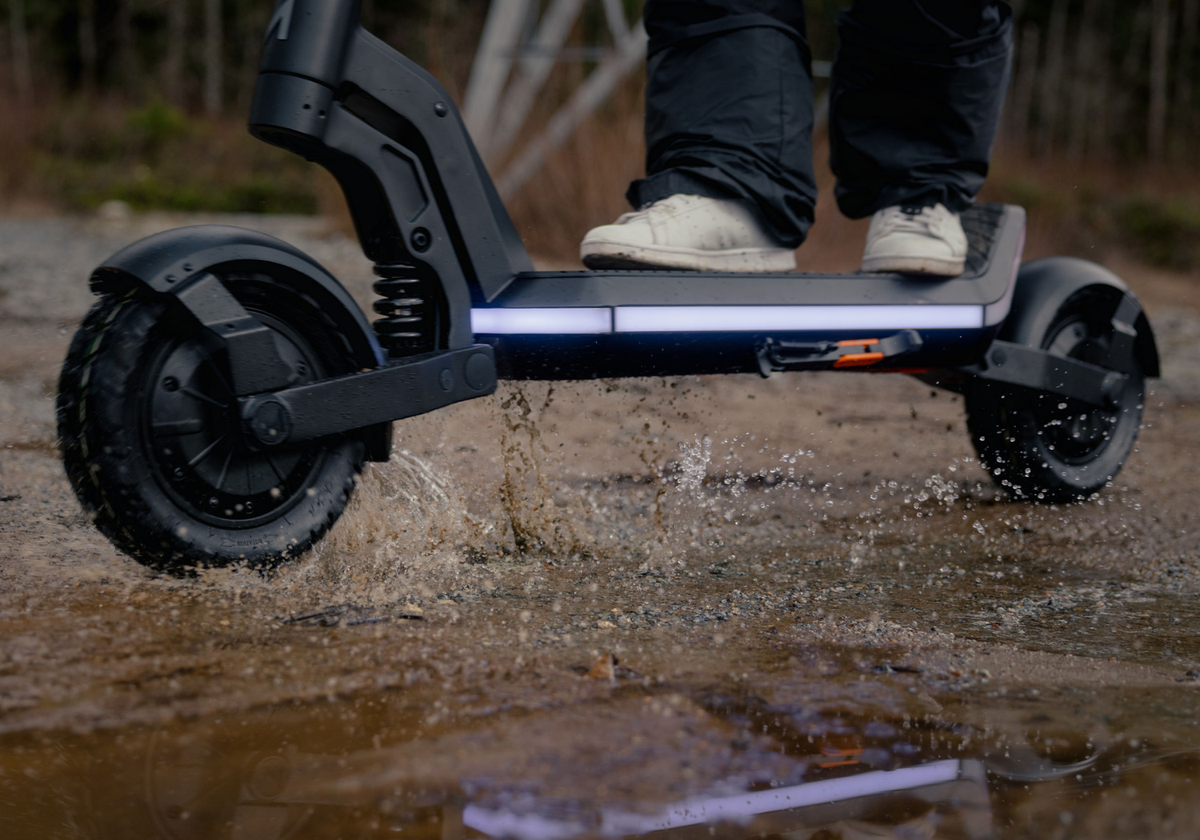
An IP (Ingress Protection) rating is a standardized, testable way to describe how well a device resists solid objects like dirt and liquids like water, replacing vague marketing terms like "waterproof." An IP66 rating means a scooter is fully dust-tight and can withstand powerful water jets from any direction, which covers riding in heavy rain and washing the scooter down with a hose. It does not mean the scooter can be submerged.
This rating matters more than it might seem. Keeping a scooter perfectly dry isn't realistic between unexpected weather, puddles, sprinkler systems, and the occasional hose-down during cleaning.
Why does UL 2272 certification matter?
UL Solutions testing signals independent, third-party verification that a scooter's design meets defined safety requirements. For electric scooters, the standard to look for is UL 2272, which covers the complete electrical drive system, including the battery pack, motor, and charging circuit. A related but narrower standard, UL 2271, covers only the battery pack itself.
WHY THIS IS WORTH CHECKING
Lithium-ion battery fires burn hot, produce toxic fumes, and are difficult to extinguish. Many municipalities, transit systems, and buildings now require UL 2272 certification for scooters and e-bikes on their premises. Look for UL 2272 specifically, not just UL 2271, when comparing scooters.
How much does scooter weight matter?
Weight climbs alongside range, speed, and suspension. In motion, a heavier scooter's low center of gravity keeps it stable, even at walking speed, unlike a top-heavy vehicle such as a motorcycle. Where weight matters is lifting the scooter: onto a bus, up a flight of stairs, or into a trunk. Most scooters, including the full Apollo lineup, fold with the steering tube locking to the deck to form a carry handle, but having a handle and being able to comfortably carry the scooter are two different things.
As a general guide: the 43-lb Dash, and to a lesser extent the 55-lb Go Stellar, are manageable solo for stairs and public transit. The 72-lb City 2.0 and especially the 102-lb Phantom 2.0 are more of a job, they can still be carried, but it will require someone stronger or bigger. Funny fact: Some riders have told us they consider this part of their workout.
What isn't listed on a spec sheet?
Some of the most relevant differences between scooters never make it onto the spec table. Worth researching separately:
-
Does the companion app offer useful features like ride stats, custom settings, and anti-theft tools?
-
Anti-theft features: NFC unlock, Apple Find My, or other IoT tracking.
-
Availability of product support, spare parts, and service centers near you.
These shape the whole ownership experience in ways a top speed or watt hour figure never will.
Putting it together
There's a wide range of electric scooters on the market from a wide range of manufacturers, and specs only become useful once you've worked out what you actually need. A smaller, less expensive scooter that meets your needs can beat a more capable one that's harder to carry upstairs or store, just as a more capable scooter can be worth the extra weight and cost if your rides call for more range or steeper hills. UL 2272 certification is worth treating as non-negotiable regardless of which model you choose: it's a safety baseline, and increasingly a legal one in more places.
QUICK RECAP
Match top speed and range to your actual commute, not the biggest number available. Use watt hours, not just voltage or Ah alone, to compare battery capacity across brands. Confirm UL 2272 (not just UL 2271) and an IP66 rating before you buy.
Frequently asked questions
What does top speed mean on an electric scooter spec sheet?
Top speed is the maximum achievable speed for a light to mid-weight rider (120 to 165 lbs) on flat ground, on a full battery, in the highest speed mode. It is not a sustainable cruising speed, and most US and Canadian jurisdictions cap legal e-scooter speeds at 15 to 20 mph regardless of what the scooter can do.
What is the difference between nominal and peak motor power?
Nominal power is the wattage a motor can sustain continuously without overheating, and is the better indicator of everyday performance. Peak power is the higher wattage a motor can deliver briefly, for example during hard acceleration or a short steep climb, before the controller pulls back to protect the motor.
How do you read an electric scooter's battery specs?
Battery capacity is usually listed as voltage (V) and amp hours (Ah), such as 48V 13.45Ah. Multiplying voltage by amp hours gives watt hours (Wh), which is the most reliable single number for comparing real-world range across scooters and brands.
What does an IP66 rating mean for an electric scooter?
IP66 means a scooter is fully dust-tight and protected against powerful water jets from any direction, so it can handle rain, splashes, and a hose-down. It does not mean the scooter is submersible, so riders should still avoid deep puddles and standing water.
Why does UL 2272 certification matter for an electric scooter?
UL 2272 is independent third-party testing of a scooter's complete electrical drive system, including the battery, motor, and charging circuit, for fire and electrical shock risk. It's more comprehensive than UL 2271, which covers only the battery pack, and many municipalities and transit systems require UL 2272 for indoor storage or transport.