



How do I keep my Electric Scooter Safe?
We all love and depend on our scooters. However, we’re not the only ones who fancy our scooters, and unfortunately some are willing to steal them.
Electric scooters are more portable compared to E-bikes which makes them great for commuting, but it also makes them attractive theft targets. A thief can easily transport a stolen scooter inside an automobile out of sight, quickly, without anyone noticing.
Understanding how to prevent theft is a necessary component of electric scooter ownership. And no, it’s not only about buying a lock, although that’s an important part of it. Here we share some best practices on how to lock them & where to lock our scooters to ensure they are safe and sound.
Scooter theft prevention tips
First, we recommend taking your scooter inside with you any time that’s an option. Keeping the scooter in your presence; for example storing it in your home, office or cube rather than locking it up outside. Taking it with you inside establishments and on errands when possible is the best anti-theft solution. (Too simple, right?) But, we get that’s not always possible. So here are a couple of other options.
Our second recommendation is for you to use smart scooter anti-theft features, such as electronic locking, NFC, and IoT (internet of things remote locking and tracking) and Apple Find My (lost item tracking). These of course, entirely depend on the included features of your electric scooter (something to keep in mind when looking to buy a new scooter).
Third. Use a good quality physical lock. So How do you lock up a scooter correctly?
This is what this blog post will focus on. Always bear in mind that a physical lock is only one part of the strategy to maintain possession of an electric scooter (or any PEV).
How do thieves break scooter locks??
The Enemy! Scooter theft is not only done by people who are simply looking to do a prank, in many cases, theft is done by “professionals”; they do this frequently. They have sophisticated tools that can break into most locks they come across. Some will pick locks, but most will cut through them.
Recent innovations in construction tools have given “professionals” convenient devices to defeat locks. Lock destruction and theft is an application these tools were not designed for, but can easily be repurposed to accomplish. We are all familiar with “old school” bolt cutters but consider the battery-operated angle grinder with a diamond blade, or a hydraulic rebar cutter. These tools are much more portable and powerful then “your old timer” thieves bolt cutters.

These construction tools can defeat all but the most robust locks, if thieves are given the opportunity to use them, especially in places not highly visible to the public and electric scooter owner. In many urban areas, the public is so callous to mischief and “not wanting to get involved” thieves can spend a considerable amount of time cutting through locks if full public view.
Locks are manufactured with key types, combination mechanisms are available too. Nominally unless the locking mechanism is of low quality most locks are defeated not by picking but rather by cutting them apart. Locking devices come in a variety of styles and robustness. As robustness increases, so does cost and weight. Common lock types include cable locks, U Locks, folding locks and disk locks. Each has various advantages and limitations.
How do U-locks, folding locks, and cable locks compare?

The cable lock has the advantage of flexibility. It can be coiled up and put in a backpack for easy storage. These are available in combination and key operation as well as many lengths and cable diameters. Limitations: Low resistance to angle grinder attacks. But, if used for a quick stop, where you have visibility of your scooter at all times, it comes in quite handy.
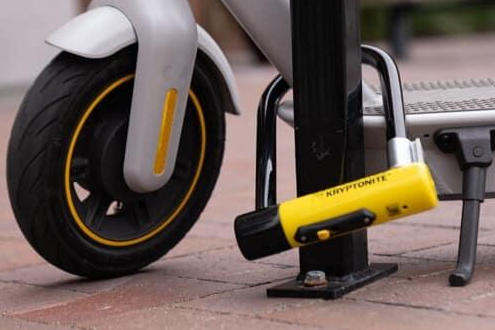
The U lock is also available in many sizes, materials and diameters. Many key security levels are available as well as materials that can be highly resistant to cutting and grinding. Generally these are the most “secure” of the lock types offered. Limitations: Shape is non flexible, can be difficult to secure things with, highly secure variants can be heavy and expensive.
The Abus Granite Extreme for example currently sells for $ 291 USD on Amazon and weighs in at 1.8Kg (just under 4 pounds). Obviously as the name suggests, this is an extreme example. U locks are available in many price points and security levels.

Folding locks fit somewhere between cable locks and U Locks. Offering more robustness than equivalent cable locks, and more flexibility than U Locks. Various styles are offered, they fold to a small size and are easily storable and transportable. Limitations: not as theft resistant as better U locks, can scratch finish of scooter.

Disk locks are small and very convenient. Ideal as a secondary deterrent to one of the other locks above, or for minimal security measure requirements such as preventing children, roommates etc. from accessing a scooter at home. They can fit in a jacket pocket and don’t weigh much. Limitations: they can only be used with disk brake equipped scooters where the lock can be secured on holes in the disk. The scooter can still easily just be carried off and loaded into a waiting car or van. But could be very useful if paired with another type of lock.
Handcuff style locks are a recently popular type of PEV scooter lock. They can be operationally convenient. Limitations: lots of different parts to potentially attack and defeat, relatively new unknown if thieves will find quick methods of cutting/removing them.

What locking mistakes put scooters at risk?
The highest security lock does little good when not used properly. It is important to ensure you’re locking your scooter to something strong and properly secured to the ground or wall. We’ve seen cases of people securing their scooters to things that can just be picked up, or poles where they can just push the lock out and up. Here are some examples to avoid:
-
Something that can be easily cut: If one locks a scooter to something easily cut, like a chain link fence, a thief may well just cut the fence links and carry the scooter away.
-
Locked to something that can be detached or disassembled: The steering tube of an Apollo scooter seems like a secure place. Since the handlebars won’t fit through the lock. However, the entire headset can be removed with 6 screws and the brake cables unhooked quite quickly (remember assembling your scooter). The lock slipped over the open tube and the scooter then re-assembled. This holds true for most electric scooter models from all manufacturers.
-
When one puts the lock through the wheel of a single motor scooter. Often the wheel can be removed, remaining locked to the bike rack etc. The rest of the scooter and a non-motorized wheel is inexpensive to replace.
So how do you lock your scooter securely? Lock your scooter through a frame part, or where the deck connects to the steering assembly.

When making a decision on what lock to buy and employ, remember some key points. Consider your theft risk and the value of your scooter when deciding how secure a lock you will require. Nothing is 100% secure, the point is to substantially decrease the opportunity to steal your scooter.
Final thoughts: The best lock is the one you will use! If you purchase a lock that is too inconvenient to use, your scooter is unlocked! A lock is only part of a best practice strategy to prevent theft of your scooter. The best theft deterrent will always be lack of opportunity!